
Lyrandar Airship
Contents
 House Lyrandar
During the Last War and in its wake, artificers across Khorvaire made many magical and mechanical advances—but none quite as impressive as the elemental airship. With its intricately carved soarwood hull and distinctive ring of elemental energy, the airship is the most advanced elemental-powered vehicle in all Khorvaire.
The first airships appeared only a handful of years ago, the product of a collaboration between the workshops of House Cannith, dragonmarked heirs of House Lyrandar, and elemental binders in Zilargo. Only a dragonmarked heir with the Mark of Storm can easily use an airship’s magical helm to control the elemental bound to the vessel and pilot the ship, so House Lyrandar maintains a monopoly on airship travel and services. Some cunning inventors seek to develop ways to undermine House Lyrandar’s control of the skies, but for now, adventurers look to Lyrandar airships as the foremost means of transcontinental travel.
What is it?
The airship is the most advanced elemental-powered vehicle on Eberron, the pride of House Lyrandar and the forerunner of the magical advances that many hope will become commonplace in the aftermath of the Last War. The first airships emerged from the Cannith and Zilargo workshops and appeared in House Lyrandar’s service just eight years ago (in 990 YK). For now, though, they remain rare, because the soarwood required for their construction is exceedingly scarce and tightly controlled.
Soarwood is a form of buoyant timber found only on the island of Aerenal, and the elves who live there limit their annual harvest of the precious wood. As a result, production of new airships proceeds at a snail’s pace, unable to satisfy the fervent demand for new vessels. The discovery of a new supply of soarwood could literally change the world, and even convincing the elves of Aerenal to part with more of it would be an achievement worth a handsome reward from House Lyrandar.
How It Works
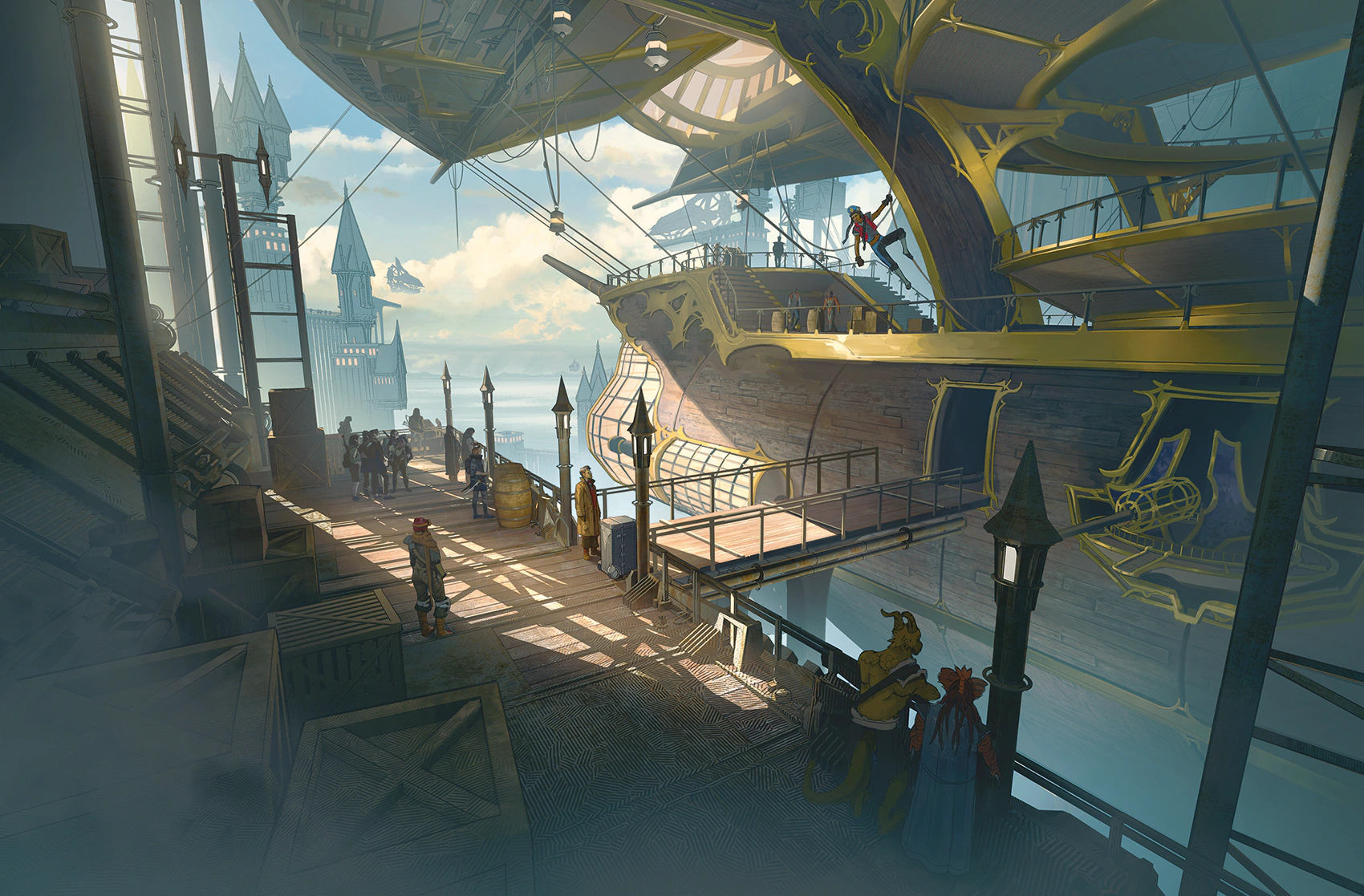
A standard airship (at least as far as standards have been defined for this relatively new creation) looks similar to an oceangoing ship but is rigged with control fins and rudders rather than sails. An air or fire elemental is bound into a ring around the hull, which is suspended on four struts jutting outward. Most airships are outfitted with the finest amenities, including many decorative flourishes and creature comforts.
Operation
Whether hiring a means of overland travel or seeking to take a crew of their own to the skies, characters are likely to encounter elemental airships during their adventures in Eberron.
Crew Members and Stations
The standard crew of an elemental airship consists of one captain, one pilot, and one or more additional crew members to operate the ship’s other systems.
Each crew member is assigned by the captain to operate one of the ship’s systems at a crew station: either the Helm described below or a station detailed in the ship’s description. Each crew station has its own Armor Class and Hit Points separate from the airship. If a crew station is reduced to 0 Hit Points, it becomes inoperable, and crew members can no longer access any of its actions. If a crew station is the target of the Dispel Magic spell, it becomes inoperable for 1 minute.
Some crew stations may require the crew member operating it to have a specific dragonmark. Other stations don’t require them but afford benefits if their operators bear certain dragonmarks. This represents a dragonmarked crew member channeling their unique talents to bolster a ship’s abilities.
Piloting without a Dragonmark
Helming an airship that typically requires a dragonmarked pilot is difficult—but not impossible. At your DM’s discretion, you can use the following rules for piloting a ship without a dragonmark.
On its turn, a creature without the Mark of Storm occupying the Helm can attempt to take the Drive or Shift Engine action and make a DC 20 Intelligence (Arcana) or Charisma (Intimidation or Persuasion) check to command the engine’s elemental spirit. On a successful check, the action happens. On a failed check, nothing happens, and the creature’s action is wasted.
Magic can make an airship’s elemental spirit more receptive to commands. Casting Charm Monster targeting the elemental spirit gives you Advantage on checks made to command the spirit for the spell’s duration. If you instead cast Dominate Monster targeting the elemental spirit, any checks you make to command the spirit for the spell’s duration automatically succeed. The elemental spirit automatically fails its saving throw against these spells, and you do not need to see the spirit to target it if you’re occupying the Helm.
Elemental Engines
Airships are powered by an elemental spirit bound to a core carved from a Khyber dragonshard. This core is placed into a heavily fortified containment chamber connected to an arcane matrix spanning—and powering—the whole ship. When the elemental spirit within the core is activated, its elemental energy flows through the matrix’s arteries and the ship’s binding struts, forming the distinctive ring attached to every airship. The appearance of a ring depends on the type of elemental spirit bound to the core; for example, a fire elemental spirit generates a blazing ring of orange flames, while an air elemental spirit creates a ring of lightning and occasionally sends jagged lightning bolts streaking across the ship’s surface.
Suppressing the Elemental Core
At the command of the airship’s pilot, the elemental core can be suppressed, causing the elemental energy to disappear and flow back into the Khyber dragonshard core.
An airship’s elemental core and connecting arcane matrix are magical effects. If a section of an airship enters an area of antimagic, such as that produced by the Antimagic Field spell, the weapons and other services in that section of the ship are inoperable.
If the ship’s elemental core enters an area of antimagic, the elemental core is automatically suppressed and can’t be reengaged until the core leaves the area of antimagic. If the elemental core is the target of the Dispel Magic spell, the core is suppressed for 1 minute and can’t be reengaged for the duration.
While the elemental core is suppressed, the airship’s Fly Speed is reduced to 5 feet, though it can still hover. The airship’s Helm is still operable, but crew station actions that require the elemental core can’t be used while it is suppressed.
Breaking the Elemental Core
Shattering the core’s Khyber dragonshard releases the elemental spirit bound to it. The shard has AC 17; HP 10; and Immunity to Piercing, Poison, Psychic, and Slashing damage. If an airship’s elemental core is broken, the ship ceases to move (though it continues to hover if airborne), and crew station actions that require the elemental core are disabled.
To prevent such catastrophic sabotage, most airships keep their elemental cores inside heavily fortified and guarded containment chambers. Each ship has unique protections for its elemental core; one ship might have its core sealed in a trapped adamantine chest inside a hidden room, while another ship might guard its core with an arcane glyph alarm.
Wind Wards
In addition to powering an airship’s movement and crew stations, the elemental engine also fuels the wind wards that surround the ship as it travels. These wind wards help provide a comfortable travel atmosphere aboard the ship.
While the wind wards are active, creatures aboard the airship can breathe normally and the deck is free from winds. In addition, creatures on the ship have Advantage on saving throws to avoid being pushed off the deck of the ship, as the wind wards provide a buffer. If the elemental core is suppressed or destroyed, creatures aboard the airship might suffer the effects of high altitude and strong wind.
A dragonmarked heir of House Lyrandar must pilot a Lyrandar airship, channeling the power of the Mark of Storm through the wheel of wind and water that controls the vessel. The helm is typically situated near the rear of the ship, inside the shelter of a wheelhouse. Controlling the vessel (without the benefit of something like the conductor stones that dictate a lightning rail route) requires constant attention, so at least two pilots typically travel on every journey.
Only a dragonmark heir with the Mark of Storm can use the wheel and command the bound elemental. House Lyrandar pilots train for months to gain a deep understanding of the ship’s powers and limitations. Because of this training, a skilled pilot can execute acrobatic maneuvers in the sky.
Airships can move in all three dimensions, with or without the aid of the wind. Unlike most flying creatures, they don’t rely on wings for lift thanks to their soarwood hulls. They are able to fly equally well on their sides or even upside down (notwithstanding the risks that such maneuvers present to passengers and crew).
Airships cannot actually land, because the struts that hold the elemental ring in place protrude 10 feet from the bottom of the vessel. Thus, passengers and cargo are lifted in elevators and loaded at towers in major cities. Each ship carries rope ladders for use at smaller stations, in open terrain, or in cases of dire emergency.
A typical airship can reach a speed of 20 miles per hour in clear skies carrying up to 30 tons of cargo. Airships are most often employed by explorers and by wealthy travelers who demand luxury — clients who have a need to move quickly to places that might not be served by the lightning rail.